Stocks plunge amid bad service sector report
Activity accounts for two-thirds of economy, first contraction in four years
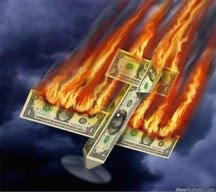
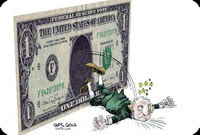
Recession fears hammer Wall Street
MSNBC
February 5, 2008
Market update
Index Last Change % change
• DJIA 12265.13 -370.03 -2.93%
• NASDAQ 2309.57 -73.28 -3.08%
• S&P 500 1336.64 -44.18 -3.20%
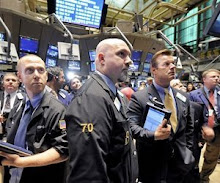
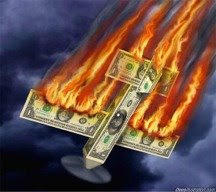
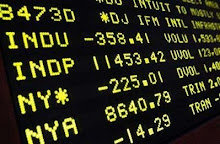
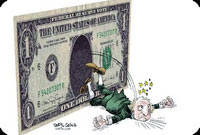
NEW YORK - Wall Street plunged Tuesday, driving the Dow Jones industrials down 370 points after investors saw an unexpected contraction in the service sector as evidence the economy is sinking into recession. It was the Dow’s biggest percentage drop in almost a year.
The volatility that pummeled stocks in January returned with the news that the service sector shrank last month for the first time since March 2003. The report from the Institute for Supply Management wiped out the nascent optimism about the economy that had sent stocks surging higher last week.
“The report drives a nail into the coffin from investors’ minds that we’re in a recession,” said Todd Salamone, director of trading at Schaeffer’s Investment Research. “That doesn’t mean stock prices in the months ahead will be lower. But when you see headline numbers like this, there tends to be a reactionary sell.”
The ISM said its index of service sector activity, which accounts for about two-thirds of the economy, dropped below 50, a level that indicates contraction. Economists had expected another month of growth.
“This is an absolute collapse of this index,” said Nigel Gault, chief U.S. economist at Global Insight.
It’s possible the service sector, which includes businesses ranging from restaurants to retailers to banks, could bounce back in February as the manufacturing sector did in January after its December contraction. The benefit of the Federal Reserve’s two big interest rate cuts in the latter part of January could also help spur the service sector back into growth mode later this year.
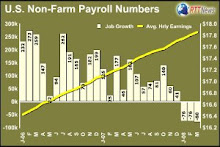
Still, the data was particularly worrisome given last week’s Labor Department report, which showed that the U.S. economy lost jobs in January for the first time in more than four years. Together, the two reports indicate that the ongoing credit crisis is dragging down the actual economy.
Fitch Ratings’ plans to lower the rating on more than $100 billion wrapped up in bond funds called collateralized debt obligations added to the host of concerns plaguing Wall Street. Downgrades would mean the securities — many of which are backed by mortgages — are worth even less than many investors thought. That could cause more problems for strugging banks, brokerages, and bond insurers.
According to preliminary calculations, the Dow fell 370.03, or 2.93 percent, to 12,265.13, after falling 108 points on Monday. Tuesday’s slide was the blue chip index’s largest one-day percentage drop since it lost 3.3 percent on Feb. 27, 2007, and its largest point drop since it fell 387 points last Aug. 9.
The broader Standard & Poor’s 500 index lost 44.18, or 3.20 percent, closing at 1,336.64, while the Nasdaq composite index lost 73.28, or 3.08 percent, to 2,309.57.
The Dow and S&P drop was the worst one-day percentage decline since February 27, 2007, the when a falling Chinese exchanges roiled the world markets. It was the 13th worst-ever point decline for the Dow, according to the Wall Street Journal's Web site.
In Monday and Tuesday’s trading, the Dow gave up most of the gains it made last week, when it jumped 536 points, or 4.39 percent. It’s not surprising that the volatile market would pull back; some analysts claim stocks should be near their bottom given how low investors sentiment is right now.
According to JPMorgan equities analyst Thomas J. Lee, the three worst readings on record in the ISM’s service sector index are associated with stocks rising in the ensuing three months — on average, by 6 percent.
Even if the stock market is near its low point, though, it has a lot of ground to recover. The Dow is down more than 13 percent since its Oct. 9 record settlement of 14,164.53. Meanwhile, the S&P 500 — the measure most watched by market professionals — is down 8.9 percent for the year, the worst year-to-date performance for the index ever. The S&P 500 has fallen 14.6 percent from its Oct. 9 high.
For the rest of the article:
http://www.msnbc.msn.com/id/3683270/



Divided Jerusalem

























































+and+Iran%27s+Ahmadinejad.jpg)


























































.jpg)




































.jpg)




.jpg)








































































































































.jpg)




































































+and+FM+Livni.jpg)



























































































No comments:
Post a Comment