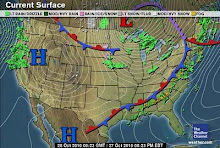
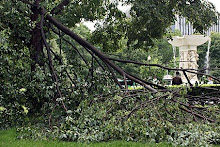
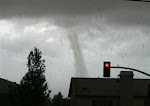
Our wild weather of record snowfalls, ice, record tornadoes and cold began on December 5, 2007 with a Pacific Northwest Storm that lashed the Northwest and continued across the country, whipping the midwest and north/northeast. These record setting weather events, nationwide, have continued to this day.
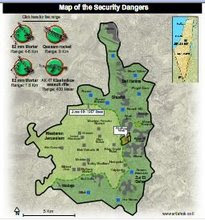
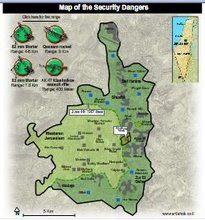
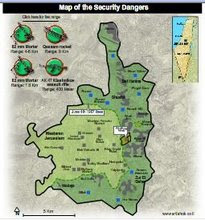
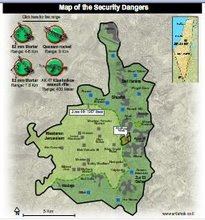
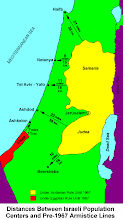
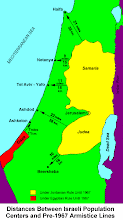
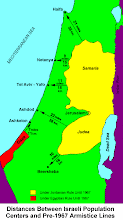
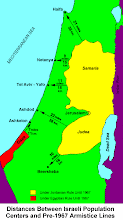
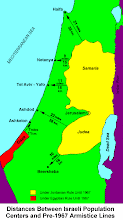
The week before these storms started forming, the USA, Israel and the Arabs were wrapping up their historic meeting at the Annapolis Conference where they agreed to divide up Israel and Jerusalem. Disregarding the Word of God which declares that in the last days God would bring the House of Israel back into their land, never to be removed again.
Judgment we have brought upon ourselves. Physically, economically and spiritually. With no national sign of repentance but a determination to go our own way and rebel against God, all that is left is the economic crash and the invasion of our enemies. Even both are well underway.
To the body of Christ I say: Watch and pray that you are accounted worthy to escape all of these things that are coming upon the earth and to stand before the Son of Man. (Luke 21:36)
Record snowfalls mean big meltdown
By Doyle Rice, USA TODAY
March 8, 2008
http://www.usatoday.com/weather/climate/2008-03-06-winter_N.htm
For snow-weary residents of the Midwest and New England, spring can't come soon enough.
Locations such as Madison, Wis., and Concord, N.H., endured their snowiest winter since records began, and parts of the western USA also saw a much snowier-than-average winter, according to NOAA's National Climatic Data Center.
The U.S. winter of 2007-08 — which meteorologists classify as the months of December, January and February — will go down as the coldest since the winter of 2000-01, with a national average temperature of 33.2 degrees, NOAA reported Thursday. Yet, despite the chill, the winter was still slightly warmer than the 20th-century average of 33.0 degrees.
However, it's the snowfall that may be the most memorable element of this winter.
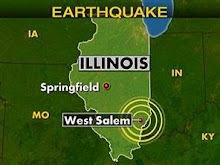
"We had 13 inches of snow on Feb. 1 alone," said Springfield, Ill., resident Julie Becker. "We haven't had 13 inches of snow in years."
In Madison, the 88.3 inches of wintertime snow shattered the all-time record of 76.1 inches, set in the winter of 1978-79, according to the National Weather Service.
Concord recorded 100.1 inches of snow this season, stressing roofs and frazzling drivers' nerves. Before that, the record had been 78 inches, set during the winter of 1886-87, according to the weather service.
The heavy New England snow has forecasters worried about what will happen when it melts. The weather service warned last week that the seasonal flood potential is "above to well-above normal" for the Connecticut River and its tributaries. Forecasters say a rapid warm-up, combined with more heavy rain, could add to the danger.
In the drought-plagued West, the snowy winter has an upside. "The high snowpack is good news there," says climatologist Jay Lawrimore of the climatic data center. The Natural Resources Conservation Service reports that the deep snow means Colorado's water supplies could be the best in more than a decade.
Three straight months of above-average snowfall will benefit residents of Arizona, California, Kansas, Nebraska, New Mexico, Texas, Utah and Wyoming because runoff from the Colorado mountains feeds rivers that run through those states.
The La Niña climate pattern — a periodic cooling of the waters of the tropical Pacific Ocean — "certainly contributed to what we saw this winter in the USA," says Lawrimore.
The current La Niña pattern is expected to continue through the spring, which could mean below-average precipitation across the South, which also suffers from prolonged drought, NOAA's Climate Prediction Center reported Thursday.
Other likely effects this spring are warmer-than-average temperatures in the Southeast, cooler-than-average temperatures in the West and wetter-than-average conditions across the Pacific Northwest, reports the prediction center.
Although final global numbers for winter won't be available until next week, some locations enjoyed their warmest winter ever, including Sweden, Finland and Latvia, according to wire reports. In December, January and February, the average temperature in Stockholm, for example, was 36 degrees — the highest mark since recordkeeping began in 1756.
At the same time, other parts of the world, including China, India, and the Middle East, have endured an extremely cold, snowy winter. Intense storms killed dozens and snarled travel in China in January.


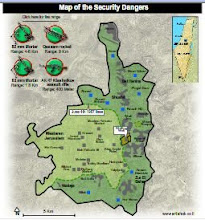
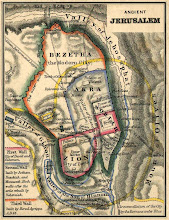
Divided Jerusalem





























































+and+Iran%27s+Ahmadinejad.jpg)





























































.jpg)


































.jpg)





.jpg)































































































































.jpg)









































































+and+FM+Livni.jpg)





























































































No comments:
Post a Comment